
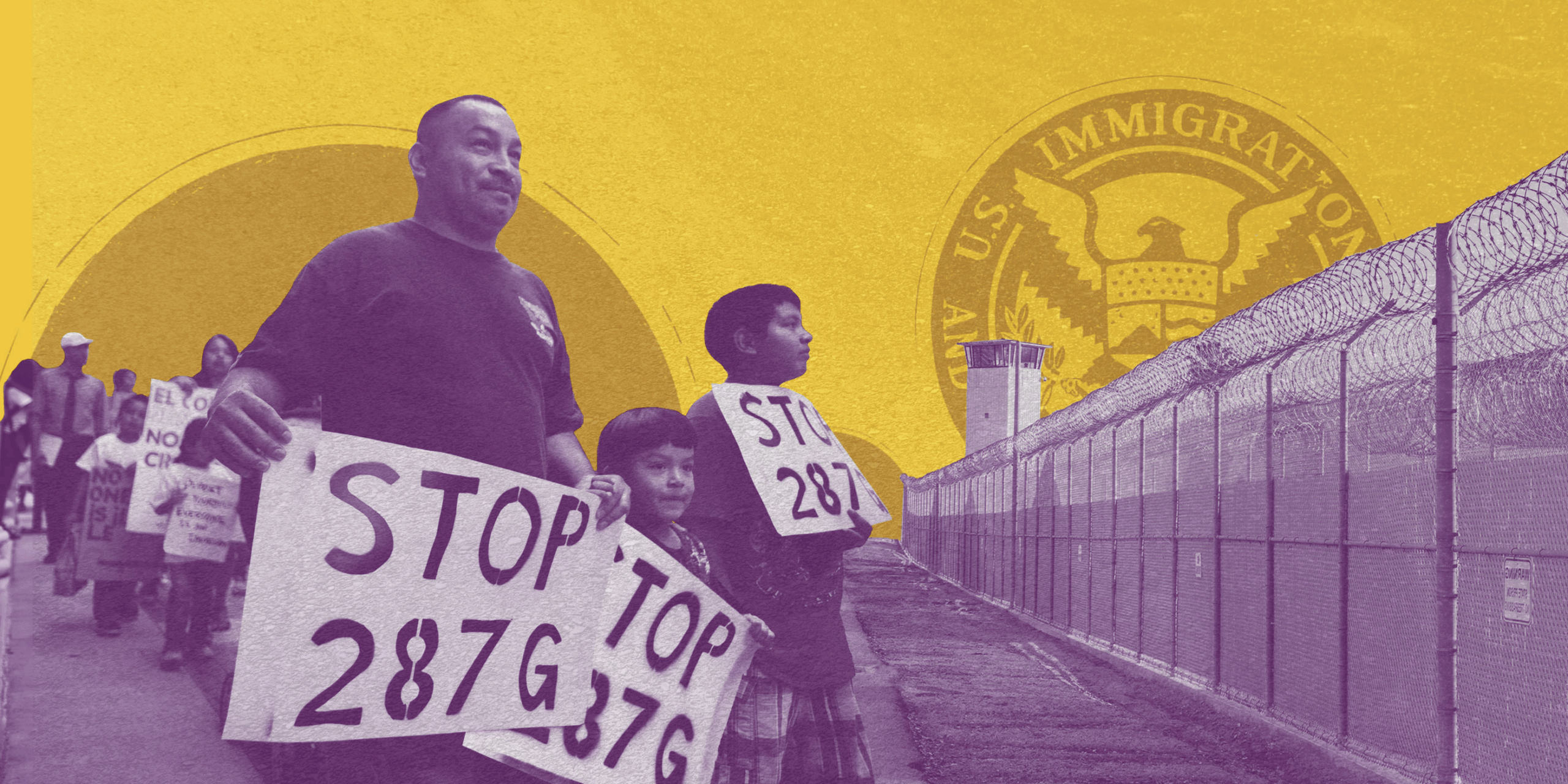
Stop 287(g) Agreements
Last updated on August 19, 2025
Stop 287(g) Agreements
Download our toolkit to learn more about the harms of the 287(g) program and what you can do to reverse these harmful agreements.
Download our toolkit to learn more about the harms of the 287(g) program and what you can do to reverse these harmful agreements.
287(g) FAQ
Is my county participating in a 287(g) agreement?
There are 7 counties participating in 287(g) agreements as of September 2025.
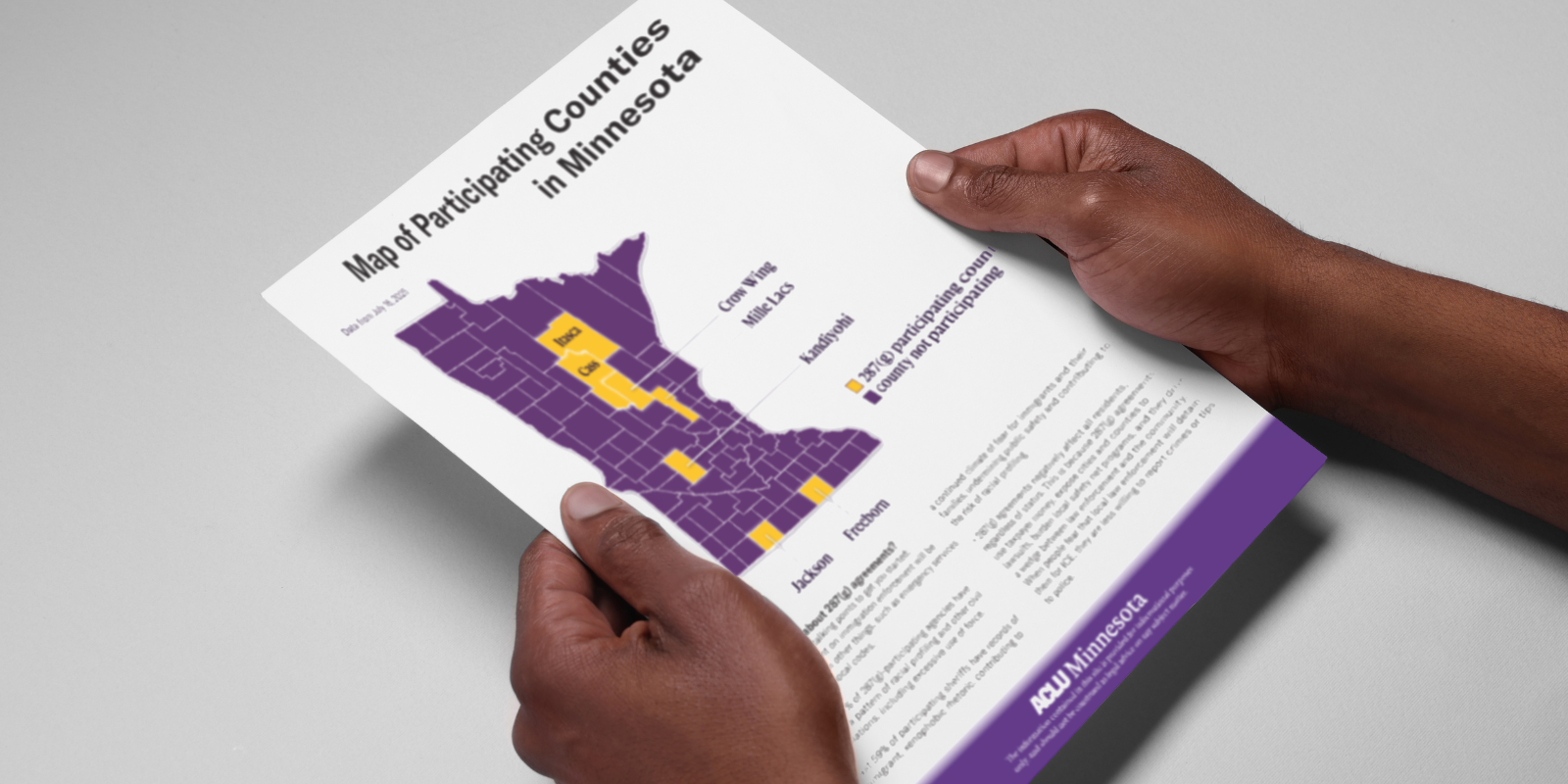
Counties participating in 287(g) agreements include: Cass, Crow Wing, Itasca, Kandiyohi, Freeborn, and Jackson counties are participating in 287(g) agreements. Check the ICE website to see if your county plans to sign a 287(g) agreement.
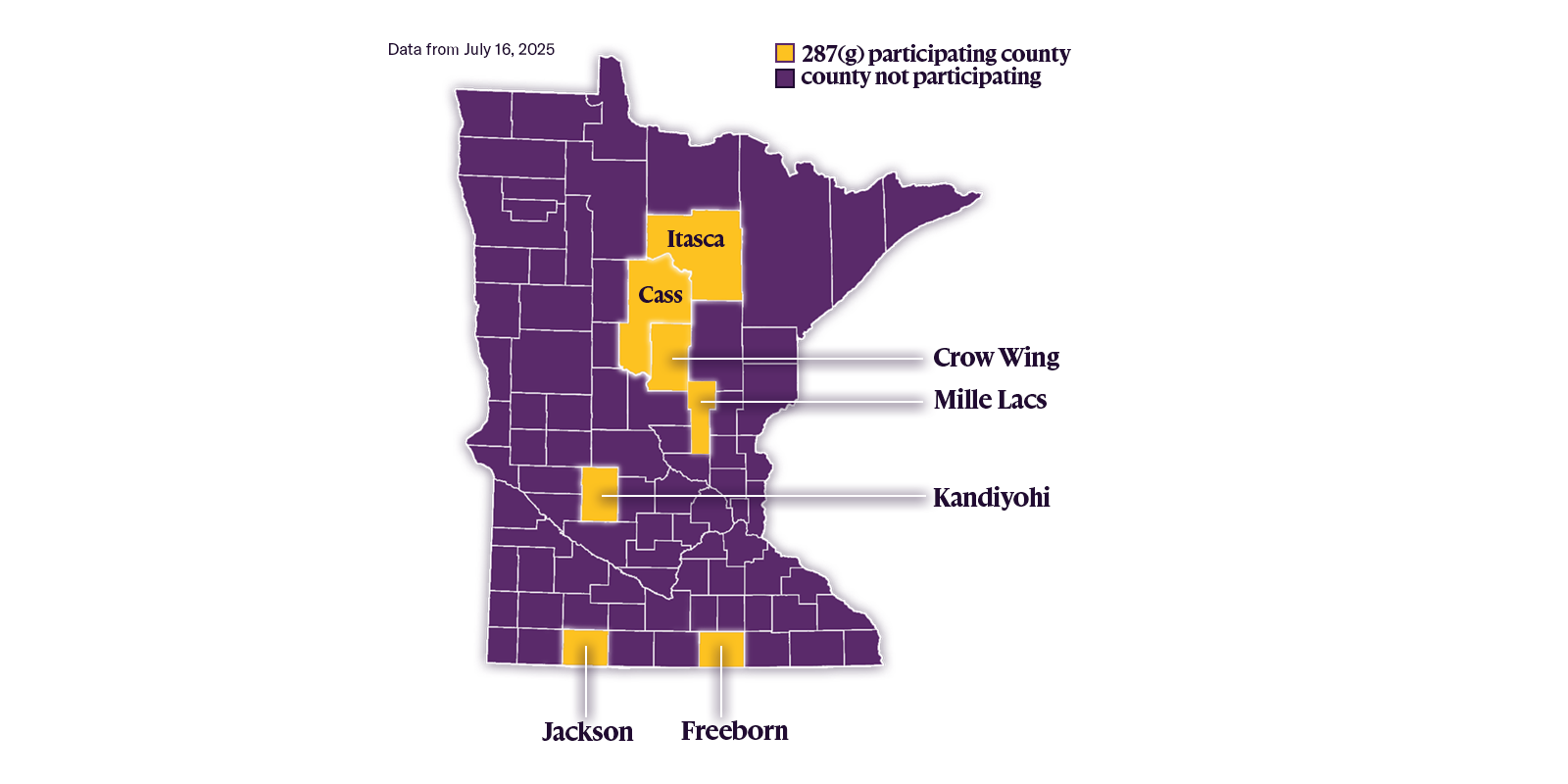
Counties participating in 287(g) agreements include: Cass, Crow Wing, Itasca, Kandiyohi, Freeborn, and Jackson counties are participating in 287(g) agreements. Check the ICE website to see if your county plans to sign a 287(g) agreement.
What is a 287(g) agreement?
A 287(g) agreement is when local law enforcement (typically a county sheriff) signs a written agreement with Immigration Customs Enforcement (ICE).
While state and federal government authorities overlap in many areas, the U.S. Constitution gives the federal government exclusive responsibility to enforce immigration law. However, programs like 287(g) aim to deputize local and state law enforcement with certain immigration enforcement powers.
Under 287(g), the federal government – through Immigration and Customs Enforcement (ICE) – forms an agreement with a state or local law enforcement agency, most often a county sheriff that runs a local jail. The agreement gives specific immigration enforcement authority to designated officers within the local agency.

While state and federal government authorities overlap in many areas, the U.S. Constitution gives the federal government exclusive responsibility to enforce immigration law. However, programs like 287(g) aim to deputize local and state law enforcement with certain immigration enforcement powers.
Under 287(g), the federal government – through Immigration and Customs Enforcement (ICE) – forms an agreement with a state or local law enforcement agency, most often a county sheriff that runs a local jail. The agreement gives specific immigration enforcement authority to designated officers within the local agency.
How can 287(g) agreements be reversed?
If your local sheriff has signed a 287(g) agreement with ICE, arrange time to speak with them. They are elected officials who serve your community so don't be afraid to speak up -- they should hear from their constituents!
Find out who is reponsible for signing the 287(g) agreement in your county and arrange a time to meet with them.
Download our 287(g) toolkit to learn more about how to start the conversation.

Find out who is reponsible for signing the 287(g) agreement in your county and arrange a time to meet with them.
Download our 287(g) toolkit to learn more about how to start the conversation.
Why are 287(g) agreements harmful?
287(g) agreements harm more than just noncitizens. It harms entire communities by redirecting money, time, and resources away from local priorities.
Reasons to for local law enforcement should avoid entering into a 287(g) agreement with ICE:
- 287(g) agreements waste taxpayer money by potentially impacting local law enforcement budgets as well as pulling law enforcement from their regular duties. Often, the federal government does not reimburse local law enforcement for their participation.
- 287(g) agreements drive a wedge between local law enforcement and the community it serves. When noncitizens fear deportation, they are less likely to call police to report crimes and tips.
- 287(g) agreements expose cities and counties to legal repercussions. For example, counties may be sued if they violate someone's right to due process. Undocumented individuals have constitutional rights too.
- 287(g) agreements lead to racial profiling.
- 287(g) agreements can put an additional burden on local safety net programs like foster care.

Reasons to for local law enforcement should avoid entering into a 287(g) agreement with ICE:
- 287(g) agreements waste taxpayer money by potentially impacting local law enforcement budgets as well as pulling law enforcement from their regular duties. Often, the federal government does not reimburse local law enforcement for their participation.
- 287(g) agreements drive a wedge between local law enforcement and the community it serves. When noncitizens fear deportation, they are less likely to call police to report crimes and tips.
- 287(g) agreements expose cities and counties to legal repercussions. For example, counties may be sued if they violate someone's right to due process. Undocumented individuals have constitutional rights too.
- 287(g) agreements lead to racial profiling.
- 287(g) agreements can put an additional burden on local safety net programs like foster care.
What should I say when I meet with local law enforcement?
Discuss data points with local law enforcement and express your concerns for your community. Click "see more" to view data points you can discuss.
• Resources spent on immigration enforcement will be taken away from other things, such as emergency services and enforcing local codes.
• At least 65% of 287(g)-participating agencies have records of a pattern of racial profiling and other civil rights violations, including excessive use of force.
• At least 59% of participating sheriffs have records of anti-immigrant, xenophobic rhetoric, contributing to a continued climate of fear for immigrants and their families, undermining public safety and contributing to the risk of racial profiling.
• 287(g) agreements negatively affect all residents, regardless of status. This is because 287(g) agreements use taxpayer money, expose cities and counties to lawsuits, burden local safety net programs, and they drive a wedge between law enforcement and the community. When people fear that local law enforcement will detain them for ICE, they are less willing to report crimes or tips to police.
• Resources spent on immigration enforcement will be taken away from other things, such as emergency services and enforcing local codes.
• At least 65% of 287(g)-participating agencies have records of a pattern of racial profiling and other civil rights violations, including excessive use of force.
• At least 59% of participating sheriffs have records of anti-immigrant, xenophobic rhetoric, contributing to a continued climate of fear for immigrants and their families, undermining public safety and contributing to the risk of racial profiling.
• 287(g) agreements negatively affect all residents, regardless of status. This is because 287(g) agreements use taxpayer money, expose cities and counties to lawsuits, burden local safety net programs, and they drive a wedge between law enforcement and the community. When people fear that local law enforcement will detain them for ICE, they are less willing to report crimes or tips to police.